

Mauritius Experiences Worst Unrest in Over 20 Years, Tourist Hotspots Affected
Mauritius, an island nation in the Indian Ocean renowned for its stunning white-sand beach resorts, is currently experiencing its most severe riots since 1999.
The protests that began last week due to water shortages and rising living costs intensified after police shot and injured a 27-year-old woman on Oct. 9. Similar protests nearly three decades ago were driven by calls to decriminalize cannabis.
ADVERTISEMENT
CONTINUE READING BELOW
Schools have been closed, and the main business association is urging companies to permit employees to work remotely.
“Once again, similar to 1999, the police are the primary target,” stated Jocelyn Chan Low, a historian and political analyst, in an interview. “The extent of the violence has escalated, with police stations and vehicles being set on fire.”
While various African nations from Morocco and Kenya to Madagascar have faced riots over living costs, power outages, and unemployment in the last two years, unrest in Mauritius is atypical.
This archipelago, reliant on tourism and financial services to support its economy, is the second wealthiest nation in Africa per capita, following Seychelles. It has held peaceful elections since gaining independence from the UK in 1968.
Nevertheless, the ongoing conflict in the Middle East has caused fuel prices to surge, and a severe drought has depleted reservoirs, leading to water-use restrictions in some regions.
Cannabis rally
The street protests commenced on October 7 in the central region of the main island, Mauritius, where roads were obstructed with shattered furniture and mattresses. The police shooting of the woman further ignited outrage, with Indian surgeons flown in to perform an operation on her to extract a bullet on Monday.
ADVERTISEMENT:
CONTINUE READING BELOW
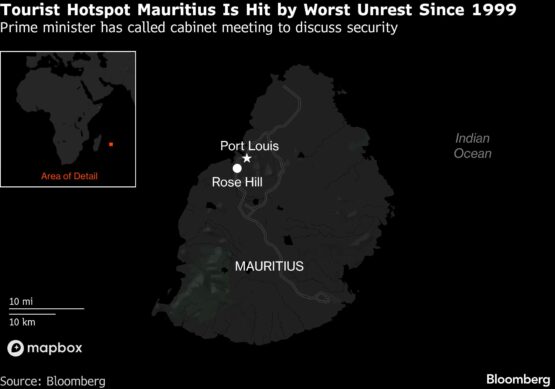
On October 12, protesters set a police station in Rose Hill, a town south of the capital Port Louis, ablaze, igniting tires and blocking roads throughout the nation.
Appeal for calm
Authorities have now reported that calm has returned, with banks and the stock exchange reopening.
“The situation is under control,” announced the Mauritius Police Force in a statement on Tuesday morning. “All roads are clear for travel.”
If the unrest does not continue, Zoë McCathie, a country risk analyst at Cape Town-based Signal Risk, believes that tourism and investor confidence are unlikely to be significantly impacted. “Mauritius continues to be regarded as a business-friendly environment.”
Prime Minister Navinchandra Ramgoolam indicated that an investigation is underway following the shooting and called for calm. The police officer who shot Elodie Thomas has been arrested and charged.
“I have emphasized the need for a swift investigation to uncover the precise circumstances surrounding this tragedy and assign accountability,” he stated on October 11. “In these distressing times, feelings of anger are understandable. However, it should not escalate into further tragedy.”
He has convened an emergency cabinet meeting for 2:30 p.m. local time to address the situation.
While future actions remain uncertain, the National Land Transportation Authority announced that bus services will conclude at 6 p.m. on Tuesday, which is earlier than usual.
© 2026 Bloomberg

