

In “You Can See Everything,” Elizabeth Holmes Faces Off Against Comedian Nathan Fielder
“Isn’t it ironic that I created a TV show based on a business fraud, and you ended up facing issues for something eerily similar … a business fraud?” comedian and filmmaker Nathan Fielder jokingly asks Elizabeth Holmes.
Just a month before the infamous Theranos CEO commenced her 11-year prison term for fraud in 2023, Holmes and her husband reached out to A24 in a fervent bid to publicly exonerate her, suggesting they film her last days of freedom. With director Lance Oppenheim involved, Fielder — known for his cringeworthy comedy that often blurs reality and fiction — embarked on the challenging mission of uncovering the true essence of the infamous Stanford dropout.
“I never really saw it that way,” Holmes responds. “I think it’s a very different scenario.”
There’s no one better than Fielder to delve into the complexities of Holmes’ psyche. His parody docu-reality series “Nathan for You” catapulted him to cult fame as he portrayed an exaggerated, deadpan version of himself who attempts to support struggling businesses through bizarre methods. In one memorable viral episode, Fielder convinces a coffee shop to rebrand as “Dumb Starbucks” for publicity, all while consulting a lawyer to navigate the tricky realms of parody law to avoid legal issues.
“If you claimed that Theranos was just a comedic skit, you might just escape unscathed,” Fielder jokes with Holmes.
“It was very real.”
“I was just making a little jest. Perhaps it didn’t land well.”
We already know that Elizabeth Holmes is not without fault. However, it remains uncertain whether she truly believes she has done anything amiss. Even during her trial — hearing testimonies from investors who lost millions, whistleblowers silenced for exposing the failings of Theranos’ blood-testing tech, and patients misled by faulty test results — Holmes maintained her resolve.
In Fielder’s metatextual comedic realm, even his most devoted fans often struggle to discern when he is acting, when he is being genuine, and whether he even understands how to differentiate between the two anymore.
In this aspect, Fielder resonates with Holmes: After over a decade in the limelight, both continue to be puzzles that captivate observers with their ambiguous identities.
“People have a narrative about me that isn’t accurate,” she confides to Fielder. “I know I didn’t commit a crime.”
[The rest of this review includes spoilers.]
At the start of filming, The New York Times had just published a profile of Holmes, which faced extensive backlash for allowing her to present herself as a well-meaning mother hoping to see her children grow up.
Regardless, Holmes and her husband, hotel heir Billy Evans, were incensed by the article.
In a conversation, Holmes informs the Times reporter that she was unaffected by Amanda Seyfried’s portrayal of her in Hulu’s miniseries “The Dropout” because “they’re not depicting me. They’re illustrating a character I’ve created.”
She and her spouse assert that the quote was misconstrued. They claim they have evidence showing that Holmes actually said, “They’re presenting a character they developed,” suggesting that she does not equate this to claiming she fabricated a false identity as the CEO of Theranos.
Fielder repeatedly asks Evans to provide this evidence to verify that Holmes was misquoted. He never presents it.
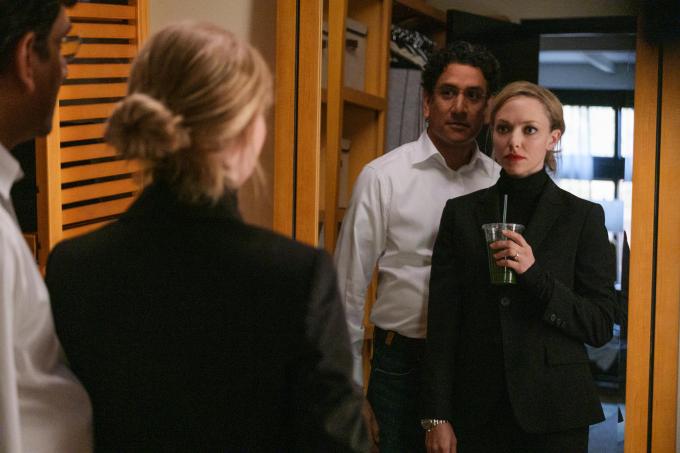
Once Holmes is imprisoned, Fielder wrestles with how to make sense of the month’s worth of footage. He enlists the ideal collaborator to help unpack her bewildering behavior: the very actress who portrays her in “The Dropout.”
Fielder shows Seyfried a telling clip from his sessions with Holmes, where he attempts to watch “The Dropout” alongside her. As they reach a fraught scene featuring Holmes’ manipulative ex-boyfriend and former Theranos associate Sunny Balwani — who is also incarcerated — Holmes can hardly bear to watch this dramatization of her life. She turns away and begins to cry.
Essentially, Seyfried sees Holmes reacting to Seyfried’s representation of Holmes, who is likely also presenting a character. However, Seyfried isn’t the only one crafting a crude imitation of the authentic Elizabeth. Evans has created a lifelike AI avatar of his wife, confined within a large vertical screen that he brings to the dining table to participate in family meals as if she were there.
The remainder of the film displays a galaxy of clashing identities. Though it is a nonfiction documentary, it is clear that everyone involved is, to varying extents, also performing for the camera. How could they not? Seyfried’s genuine intent to understand Holmes’ narrative seems heartfelt, yet viewers recognize she has recently secured a significant role in one of the year’s most talked-about films.
Simultaneously, Evans acts in such an extraordinarily reckless manner that he may intentionally be playing the villain to garner sympathy for his demonized wife.
Evans realizes that Fielder and Oppenheim question Holmes’ innocence. This documentary is unlikely to convince anyone that his wife is unjustly imprisoned. However, Evans’ appalling behavior may leave some viewers departing the theater feeling pity for Holmes, viewing her as a victim and reinforcing another persona she adopted during trial: a harmless, naive woman who was coerced by her former partner into inadvertently propagating increasingly harmful falsehoods.
Once Holmes is incarcerated, Fielder cannot bring recording devices for his visits, so he tries to script their conversations from memory, working to accurately capture the nuances of a dialogue where every word carries significant weight. With Seyfried reprising her role from “The Dropout,” they rehearse the script, adjusting the wording as Fielder strives to remember Holmes’ exact expressions and delivery.
In character as Holmes, Seyfried states, “People think Amanda’s show is a documentary. I’m treated worse [in prison] because of how she was represented.”
As she delivers the lines, Seyfried breaks character.
“I didn’t do that,” the actress interjects. “She brought that upon herself.”
When you purchase through links in our articles, we may earn a small commission. This doesn’t affect our editorial independence.

